Average Reviews:

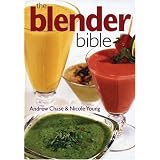
(More customer reviews)`The Blender Bible' by Andrew Chase and Nicole Young came to me as a big surprise when I opened the volume to its table of contents. Every culinary book with the word `Bible' in its title invariably comes with dozens of pages on general techniques. This book has but one page on generalities. It does not even have a section on how to evaluate blenders and the range of products you can expect at your local `Bed, Bath and Beyond' and on the interactive pages of Amazon.com. This may partly be due to the fact that the authors credit the Cuisinart Company with supplying them with machines for their recipe testing.
I do have to recant part of this rant to recognize the fact that late in the book there is a nice, three-page introduction to making baby food. Ms. Young happens to be an expert teacher on the subject of making baby foods, so I will assume that this section carries a lot more weight than your run of the mill chapter on the subject published by a blender manufacturer. This means, of course, that if baby food is one of your more important blender applications, then this book is definitely for you. Unlike all the other recipes, the baby food recipes include a nutritional breakdown, giving amounts for calories, carbohydrates, fiber, fat, protein, and iron.
I am mollified somewhat by the fact that the blender is really a very simple appliance. And, I heartily agree with the authors when they bemoan the eclipse of the blender in favor of the food processor. I firmly believe that there are tasks which the blender can handle far better than the food processor, and which cannot be done effectively by hand. While you can do as well or better than a food processor on most tasks with a very sharp knife and some rudimentary skills, you simply cannot match the results of the blender without the combined efforts of a mortar and pestle, a food mill, and a chinois. If I were forced to choose between having a blender and a food processor, I would always pick the blender.
Therefore, the better title for this book should have been `The Encyclopedia of Blender Recipes'. Appropriate to the `authoritative' tone of the title, I give this book extra credit for giving us all measurements in both English and Metric units. I really encourage any of you who do a lot of cooking to embrace metric recipe measurements, as it is so incredibly easy to size up and size down recipe sizes with metric units. And, a cookbook, which gives us the metric measurements, has already done all the hard work. My final word on this subject is that metric units are even more important with blender recipes where so many of the ingredients are measured as liquids. This advice is doubly important if you are concerned with the nutrition in the baby food recipes, as all units are metric, in grams and milligrams.
If your interest does not include baby food, your primary concern should be the quality of the recipes and the completeness of the recipe selection. As I have yet to find any cookbook on a major subject that can be said to cover its subject completely, the issue is how close does this one come.
The book's chapters beyond baby food are:
Appetizers, Dips, and Spreads26 pages
Salad Dressings14 pages
Condiments, Sauces, and Marinades36 pages
Soups50 pages
Breakfast6 pages
Entrees22 pages
Side Dishes10 pages
Desserts34 pages
Smoothies26 pages
Cocktails36 pages
It were me, I would have left out the Breakfast, Entrees, and Side Dishes chapters and devoted more space to dressings, smoothies, and cocktails, as these are the subjects for which one will naturally come to a blender book. Still, the selection is excellent in these key chapters.
Regarding recipe quality, I find the list of ingredients to be excellent, the procedure to be good, and the `tips' and headnotes to be worthwhile. There are only two things that caused me some puzzlement. First, I wondered why the recipe for bean soups pureed only part of the cooked beans and left most whole. My finest taste of black bean soup came from totally pureed soup. And, as this is a book on blender recipes, why not go whole hog and whiz down the whole thing. The other concern was in the cheese soup / Welsh rarebit recipes where there was no warning about heating the final cheese mixture too high, as there is a risk of its going grainy on you.
If you like single subject culinary reference books or you are especially fond of soups or smoothies or sauces or baby food (and you have no other good book on these topics), then this is a very good book to have. If you already have a relatively complete culinary library, you may wish to give it a bit more thought before laying out money for this volume.
Click Here to see more reviews about: The Blender Bible
More than 400 taste-tempting recipes for a household blender.
More than five million blenders are sold each year in North America. Whether a blender is used to make wonderful mixed drinks or healthy baby food, it is one of the most widely used kitchen appliances.
The Blender Bible is a comprehensive compendium that features more than 400 great recipes:
100 mixed drinks
100 baby foods
100 soups, sauces and marinades
100 other tempting recipes.
This cookbook gives a wide range of recipes to increase the use of this versatile and powerful machine, reflecting the latest research that baby food and mixed drinks each account for 40% of blender use.
Following in the successful tradition of The Juicing Bible and The Smoothies Bible this book offers a wide range of easy-to-use, kitchen-tested recipes.
The Blender Bible is the ideal recipe book for the basic kitchen reference library.
(20050703)
 Get 31% OFF

No comments:
Post a Comment